Introduction
The Brighton & Hove Cab Trade Association is one of the several trade representatives of the Brighton & Hove taxi and private-hire trade and is responding to the governments consultation for handing over local licensing to Regional Transport Authorities with what could be major and disastrous changes to the trade.
This submission document is endorsed by the following Brighton & Hove taxi and ph trade rep colleagues:
Brighton & Hove Streamline Taxis Owner Driver Association-Cooperative (Est. 1936) - Brighton & Hove Sudanese Taxi Forum - Brighton & Hove Afghan Taxi Forum – Brighton & Hove Private-Hire Association – Brighton & Hove United Taxi Driver Association
References:
‘Taxi’ ‘Taxis’ refers to hackney carriages. ‘PH’ refers to private-hire. ‘PHV’s refers to private-hire vehicles.
Background
Along with other trade reps, the BHCTA works closely with Brighton & Hove city council, East Sussex Police and local associated groups on various local trade matters. A relationship that has been in place for many years and works very well.
Over the last few years the city has been flooded with out-of-town private-hire drivers/vehicles predominantly working in the city here actively encouraged by Uber. It should be noted that whilst this is not illegal it is certainly bad & unregulated practice. Furthermore, this is an exploitation and misrepresentation of the 2015 Deregulation that only clarified the requirements for sub-contracting being the ‘Triple Lock’ and the driver licensing period of three years.
However, none of those out-of-town drivers have that close local working relationship with the city council that the local trade has. None of which have to comply with the specific local conditions of licensing contained within the ‘Brighton & Hove Blue Book of Conditions of Licensing for Drivers, Vehicles & Operators.’
Additionally. such out-of-town drivers/vehicles are unable to be monitored by our dedicated taxi and private-hire Brighton & Hove Licensing department and its five full time Licensing Enforcement Officers, nor their own respective Licencing Enforcement due to predominant remote working practices. Even if there were any changes to allow this that gave the power to local Licensing Enforcement Officers to be able to carry out enforcement on out-of-town drivers/vehicles then who pays for all the extra enforcement? Local licensing is covered by the ring-fenced local licensing fees paid by the local trade, so would the local trade pay for this? However, should Local Licensing Officers be able to carry out enforcement on non-locally licensed drivers and vehicles then there should be the facility to invoice the respect licensing council of those drivers and vehicles for the enforcement.
The Brighton & Hove taxi and private-hire trade, as a combined group, has a great deal of experience of out-of-town drivers/vehicles from areas such as Lewes, Southampton, Portsmouth, Chichester, Havant, New Forrest, Fareham and Mid Sussex, predominantly working in the city under ‘Predominant Out-of-Area Working’ (POAW), more commonly known and mistakenly known as ‘Cross Border Hiring. Many of whom breach their own respective licensing conditions.
This includes illegally using Brighton & Hove taxi ranks, illegal street hirings, purposely removing licence plates, smoking in their vehicles.. and even such drivers living in their vehicles 24/7.
The BHCTA has regular direct contact with all of these other licensing authorities due to continuously having to report the breaching of licensing conditions of their respective phv drivers.
We do not experience such predominant out of area working issues with hackney carriage taxis from other nearby Licensing Authorities due to an ‘Intended Use Policy’ applied to these vehicles as a condition of licence which works very well as referred to further on.
It should be noted that it has not been stated if the government is looking for any changes as a whole to the taxi and private-hire trade for both the ‘London Private Hire Act 1998’ for the trade within London and/or just the ‘Local Government Miscellaneous Provisions Act 1976 – Part 2’ for the trade outside of London, of which the two ‘Acts’ are very different.
Regional Transportation Authorities v Local Licensing Control
Firstly, what must be understood (outside of London) is that prior to 1976, private-hire (minicabs) were not licensed. Only hackney carriage taxis were licensed by local councils. Issues arouse where there was no control of unlicensed and unregulated private hire driver/vehicles. This led to parliament granting the right for local councils to have full control in their own areas over these drivers and vehicles. Thus, the Local Government Miscellaneous Provisions Act 1976 Part 2 for Taxis & Private Hire – Drivers, Vehicles and Operators’ was put in place. This extended what was already in place for hackney carriages under the 1847 Towns and Police Clauses Act. It was only in 1998 that minicabs finally became licensed in London.
The 76 Act was, and still is robust despite government claims that it is ‘archaic and out of date’, a claim that has never been clarified in detail.
However, Section 75(1)(a) of the Local Government Miscellaneous Provisions Act 1976, that has woefully never been enforced by any local council, states that nothing in Part 2 of the Act (which deals with hackney carriages and private hire vehicles) applies to a vehicle used to bring passengers or goods into a controlled district under a hire contract made outside that district, provided the vehicle is not made available for hire within the district.
Key Points
This section applies to vehicles operating under Part 2 of the 1976 Act, which governs the licensing and regulation of hackney carriages and private hire vehicles in designated controlled districts that have different local conditions of licensing.
The exemption is for vehicles hired under a contract (a booking) that is made in the controlled district that the vehicle is licensed in but ending the contract for hire in a different licensing area.
A crucial condition is; that the vehicle entering another controlled district must not be made available for hire within the newly arrived controlled district when that contract is completed.
This provision aims to allow for the natural movement of vehicles for hire from one area to enter into another licensing area when being hired on a contract (a booking). But, without that driver and vehicle having to comply with the same local licensing conditions requirements in that other controlled district that has been entered into where those local drivers and vehicles do have to comply to those local conditions of licensing. This is for the purpose for that out-of-town driver and vehicle to complete the hired contract/booking.
Simply put:
If a private hire vehicle from ‘District A’ is hired in ‘District A’ under a contract (a booking) and is then used to transport a passenger into another controlled ‘District B’, it remains exempt from the local licensing conditions under this section, as long as it is not then presented for hire within the controlled ‘District B’.
Ultimately, under Section 75 (1) (a) an out-of-town licensed driver/vehicle cannot accept contracts for hire within a controlled district for the purpose of staying within that controlled district without complying with the same local conditions of licensing of that controlled district.
Without this there is no point in having local conditions of licensing which is the exact reason why Parliament gave local licensing control to local authorities in the first place. Otherwise. What was the point in included Section 75 (1) (a) in the first place?
The reality of the current ‘Cross Border Hiring/ Predominant Out of Area Working’ situation has obliterated that right, granted by Parliament, for local councils to control private hire activity within respective licensing areas.
It is quite incredulous that there are plans to get rid of local licensing authorities that have served local areas since the introduction of the Local Government Provisions Act 1976 Part 2. It is very clear that the government does not believe in localism.
It has been quoted many times by the government that current legislation for the taxi and private hire trade is ‘archaic’ and even ‘not fit for purpose’. Yet at no point has there ever been listed what is archaic and fit for purpose? Unless this refers to not allowing Uber to takeover and fully control the trade for its own needs to ensure that its shareholders are kept happy.
Cross border hiring in its correct terminology has always been in place because people naturally ‘cross over’ borders when travelling. The taxi and ph trade could not operate without this.
However, what has happened is where drivers of phv’s intentionally seek licenses in areas that there is absolutely no intention of working in, but to predominantly work out-of-area, out-of-sight and out-of-mind of respective local licensing control. So this activity should not be called ‘Cross Border Hiring’ but instead ‘Predominant Out of Area Working’ (POAW).
In Brighton & Hove there is a strong dedicated taxi/phv Licensing Department with a good team of Licensing Officers working exclusively with the local trade. Licensing Enforcement checks are made every week on the streets and ranks on the local trade at ad-hoc times to ensure that drivers and vehicles are up to the required standard for public safety. Trade Forum meetings are held every four months with trade reps, licensing officers, councillors the police and associated guests.
This is how the local taxi/ph trade should work; shoulder to shoulder with Licensing Officers, the council and the police as the local drivers are the ‘Eyes & Ears’ of local activity on the streets. We are often sent messages from the police for help and also the Licensing Department via the Licensing’s dedicated ‘Whatsapp’ group. This would not be the same under the proposed and unknown, and most likely ‘faceless entity’ of a Regional Transport Authority taking over licensing as that would obliterate that local close collaboration.
The current conditions for taxi and ph licensing for drivers In Brighton & Hove are very high and would probably exceed those of some other licensing authorities of any proposed presumed national minimum requirements:
•Enhanced DBS check for the initial application for a driver/proprietor licence with the requirement for the subscription to the ‘DBS Updating Service’ for continuous live Enhanced DBS checking.
•Disability awareness training course, with refresher courses every three years.
•CSE/Vulnerable Adults awareness training with refresher courses every three years.
•English Language Test – An absolute must for communication an oddly absent for Chichester licensing requirements.
•Group 2 Medical (as applied to bus and lorry drivers) for fitness to drive a taxi/phv upon application and then every five years until the age of 65 then annually.
•For Brighton & Hove the ‘Knowledge Test’ is required to drive both taxi and phv’s as Brighton & Hove issues a ‘Dual licence’ to drive either. This absolutely ensures all such drivers have a professional aptitude and spatial awareness without the need to rely on a satnav to be able to safely concentrate on the traffic with passengers on board.
Extra Brighton & Hove Local Conditions of Licensing For Vehicles
•For vehicles, there are local conditions of licensing to ensure the required number of wheelchair accessible vehicles (WAVs) are available. These conditions apply to hackney carriages and private-hire vehicles.
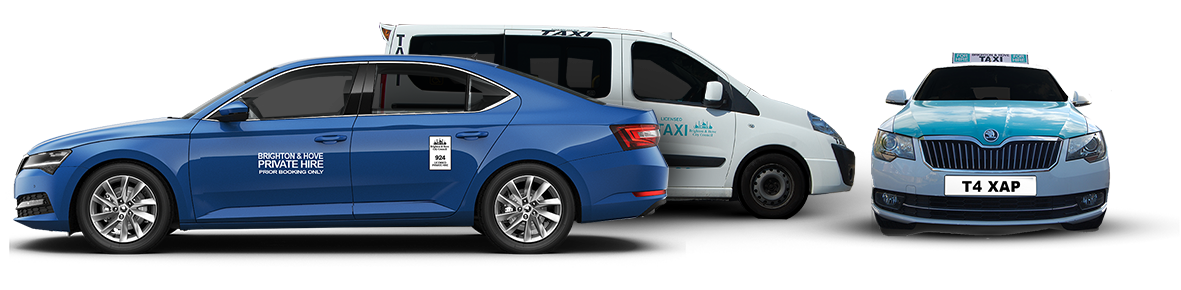
•Vehicle identification is also a priority with hackney carriage taxis having a distinct livery of a white based body with aqua boots and bonnets.
•Both hackney carriage taxis and private-hire vehicles have specific non-removable door livery on all doors that show the licence number of the vehicle as well as the rear plate. The use of magnetic council door livery and rear licence plates is strictly forbidden for public safety.
•Council controlled CCTV has been in place here for many years and works very well for the protection of the passengers and drivers. How would a Regional Transport Authority deal with such CCTV requirements when in charge of a huge area?
•A ‘Dual Driver Badge’ is issued that allows the driver to drive both a taxi and phv which has the exact same requirements such as an extensive local knowledge test.
Is this all to be taken away with a huge faceless Regional Transport Authority entity?
It is so blatantly obvious that the large proposed Regional Transport Authorities will face exactly the same issues as there are currently now with local licensing but will be on a much greater geographical scale.
The local topographical ‘knowledge’ expertise requirement that sets the high standard for a professional driver will be obliterated..
Responsibility will certainly be compromised under larger Regional Transport Authorities as this themselves will not prevent out of area working, as it just purely transfers licensing from local licensing to upper tier authorities.
The huge disruption of the time and money spent transferring local licensing to Regional Transport Authorities will mean having to move away from long standing and efficient local licensing systems and the need to devise new ones. This will include the training of new officers for the yet not known brand new legislation to be decided on.
At no time has the government produced what the expected costs will be to hand over local licensing to the newly created Regional Transport Authorities…. nor indeed…who pays for this. Will this come out of the current ring-fenced local licensing fees paid by the trade itself? Will there even be a restructure to abolish the ring-fenced licensing fee system? Will the cost of financing the new Regional Transport Authorities be paid for by central government or funded by local council tax which is something that does not happen now as local taxi and ph licensing has always been self-funding,
There will be enormous consequences of handing over local licensing to Regional Transport Authorities such as the loss of;
•Intercooperation with the taxi/ph representation on a local level.
•The local working relationship with the police where the police often contact the trade either directly or through the Taxi & PH Licensing Department for assistance.
•Working with local disability groups
•Ever evolving increase in local trade standards and specific area service requirements.
•Directly dealing with complaints on a ‘time is the essence’ basis and collecting cctv data within the required time frame of 30 days before being l lost.
•For the hackney carriage trade, the loss of producing ‘Fare Reviews’ for the local council controlled local table of fares/tariffs that are formatted for addressing specific local service requirement needs. It must be noted that Fare Reviews are not automatic such as on a regular set time frame basis.
Fare Reviews are requested ad hoc by the local trade as and when deemed to be required. In Brighton & Hove the process is set in the ‘B&H Blue Book for Conditions of Licensing’. When an agreement is reached between the trade and the Licensing Department this is then referred to the councils financial department and then reviewed by the Licensing Committee.
Once this process has been completed, the proposed fares are then locally advertised for a set time for objections. Any objection can delay the new fares being implemented. This whole process from start to finish could take at least three months.
NB: The purpose of locally controlled hackney carriage fares is to enable the public to be assured that taxi drivers can only charge what is permitted so the public knows that the fares are stable and non-fluctuating. This is very different to Uber fares which can be multiple times higher than standard due to high demand.
The prospects of having to go through this process with a Regional Transport Authority instead is predicted to be excessively complicated and laborious and will be far removed from the current locally devised and long-established procedure.
Summary and Solution
The government has clearly demonstrated its clear lack of acumen in trying to resolve an issue that it has effectively been created by itself and by the previous government with its sheer lack of understanding that the taxi and private-hire trade needs to be localised as granted by Parliament in 1976 that gave each local authority the right to control the activities of those drivers and operators that work within that local authority area.
Even with the prospect of Devolution, which itself is a system of destroying localism, the taxi and private-hire trade unconditionally needs to remain local and zoned to remain in a controlled and safe way to avoid the uncontrolled cross border taxi & private issues as raised in the ‘National Audit on Group-based Child Sexual Exploitation and Abuse Report’ by Baroness Casey in June 2025 with regards to people trafficking. In fact making licensing areas larger and controlled by a large Regional Transport Authorities will only contribute and extend the risk to public. This is such an obvious flaw in the government’s plan!
The only solution to where we are now with the current ‘wild west’ utter chaos in the streets, contributed to by the likes of Wolverhampton Licensing, is the Intended Use Policy that is currently and very successfully used by some local authorities, such as Brighton and Hove that can be enforced on hackney carriage taxis, but for whatever reason cannot be enforced on private hire vehicles?
The ‘Brighton & Hove Cab Trade Association’ and also the ‘National Private Hire & Taxi Association’ have both put forward to the recent government ‘Call for Evidence – Taxis & Private-Hire’ the ‘Intended Use Policy’ (IUP) to be applied to the vehicle, driver and operator licence.
All local councils currently have the option to apply this, but only to hackney carriage vehicle taxis.
This IUP is a condition of licensing that is applied to hackney carriage taxis (the vehicle itself) which means the driver must predominantly use the vehicle in its own licensed area. It does not stop natural cross border hiring in its natural and correct meaning…but ensures that the vehicles remain predominantly local to its licensed area and not out-of-sight & out-of-mind of respective licensing enforcement.
To stop ‘Predominant Out of Area Working’…. and curing cross border hiring as it is more commonly known, the simplest way is to make the ‘Intended Use Policy’ a national condition of licensing for all taxis (as can be applied now) and for all private-hire vehicles, drivers and operators. This would turn the ‘Intended Use Policy’ now used by some LA’s as a statutory condition of licence, rather than a ‘policy’.
This completely stops those drivers who shop around for an easy licence with the intention of never working their respective areas but with the intention of predominantly working elsewhere.
Andrew Peters
BHCTA
March 29 2026
bhcta.co.uk/regional-transport-authorities
PDF Download:
bhcta.co.uk/downloads/regional-transport-authorities.pdf
Regional Transport Authorities &The Licensing of Taxis & Private Hire Vehicles Consultation 2026
Brighton & Hove Cab Trade Association Response March 29 2026
Brighton & Hove Cab Trade Association Response March 29 2026
Taxi and Private Hire Vehicle Policy Team - Zone 2/22 - Department for Transport - Great Minster House - 33 Horseferry Road - London, SW1P 4DR – Via: email: taxisandphvs@dft.gov.uk supplied in Word & PDF March 29 2026

BRIGHTON & HOVE
CAB TRADE ASSOCIATION
CAB TRADE ASSOCIATION